
Taiwan Data Center Green Energy Policy
Following our observations on the European data center market, it has become clear that electricity and green power have evolved from supporting infrastructure into strategic prerequisites for market entry.
The EU’s mandatory regulations on data center energy efficiency, carbon emissions, and renewable energy use offer highly valuable lessons for Taiwan.
This article turns to the local context, analyzing data center demand in the tech industry, the renewable energy supply-demand balance, and how EU-like regulations could reshape local challenges and opportunities.
1.Taiwan’s Data Center Market Landscape and Power Supply Challenges
With the rise of semiconductors, AI, big data, and cloud computing, data centers have become an indispensable part of Taiwan’s technology industry infrastructure.
Global cloud service providers such as Google, Microsoft, and AWS have already established or planned data center operations in Taiwan.
Moreover, data centers are not yet classified as strategic infrastructure, resulting in an energy allocation and green power system that remains fragmented, decentralized, and lacking overall planning guidance.
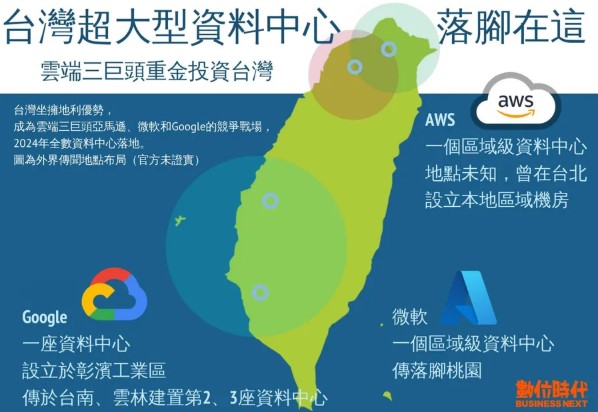
Image Source:Digital Times
Current Deployment of the Three Major Cloud Providers (Before 2024)
| Company | Number and Status of Data Centers | Site Location | Remarks and References |
| 1 operational, 2 in planning | Changhua Coastal Industrial Park, Tainan Science Park, and Yunlin Technology Industrial Park | The first data center was launched in 2013. A second facility was announced for expansion in 2019 but has yet to begin construction. A third center, planned for AI applications, also remains unbuilt. | |
| Microsoft | 1 operational | A-Top Cloud Data Center Park in Taoyuan | Announced its data center construction plan in 2020 and declared the launch of the Taiwan Azure Region at the end of 2024. |
| AWS (Amazon) | 1 operational | Chunghwa Telecom Cloud Data Center(Banqiao) | Will launch its Taipei Regional Data Center in 2025, in collaboration with Chunghwa Telecom’s colocation facilities, with an estimated investment exceeding USD 5 billion. |
Currently, data centers still make up a small share of Taiwan’s total industrial electricity use, as most energy consumption comes from semiconductor and electronics production.
Yet, the growing wave of AI and around-the-clock high-density computing is set to push data center power demand to new highs.
If Taiwan follows Europe’s ratio of 3–5% of total power usage, annual consumption could rise to 8.1–13.5 TWh, posing a new and pressing challenge for the power grid and energy policy.
2.The Current State of Renewable Energy and Green Power Policies in Taiwan
According to official data, as of the end of 2023:
- Long-term Target (2050):Renewable energy to account for 60–70% of total power generation, with 40–80 GW from solar and 40–55 GW from wind.
- Taiwan’s installed renewable capacity has reached 14.66 GW
- Approximately 27.5 billion kWh per year (around 10% of total electricity consumption)
- By 2025, the government's goal:total installed capacity of 29 GW — including 20 GW of solar PV and 5.6 GW of wind power.
Although Taiwan currently has no legally mandated renewable energy usage requirements, the government has been gradually establishing related mechanisms.
For instance, Taipower’s feed-in tariff program, the T-REC (Taiwan Renewable Energy Certificate) system, and the PPA (Power Purchase Agreement) platform have been introduced. per unit.
However, Taiwan has not yet developed virtual PPAs or regional green power markets.
In practice, major corporations such as TSMC, MediaTek, and Google have taken the lead in purchasing green electricity and actively participating in international initiatives like RE100 and SBTi.
This indicates that while Taiwan has established a foundation for renewable energy growth, further progress in regulatory frameworks and market liquidity is needed to meet the demands of both enterprises and global markets.
3.Under EU-Style Regulations, Data Centers Could Become the Ultimate Stress Test for Taiwan’s Green Energy Policy
Should Taiwan mandate data centers to report their energy usage and meet specific green power ratios — such as 50% or even 100% — they would face three key challenges:
- Securing Green Power Through Long-Term CPPAs Becomes Essential:Without long-term renewable energy procurement agreements, ensuring compliance and operational stability will be difficult.
- Uneven Regional Availability of Green Electricity:Insufficient renewable power supply in northern Taiwan could lead to site selection and investment bottlenecks.
- Lack of Flexible Market Mechanisms Leading to Price Distortion:If the green power trading system remains underdeveloped, it may result in bidding competition, price anomalies, and investor hesitation.
As a result, data centers are no longer merely back-end infrastructure — they have become critical nodes for carbon neutrality, cybersecurity resilience, and energy autonomy per unit.
Without early reinforcement of the power grid, improvement of regulatory frameworks, and expansion of wind and solar installations, Taiwan will struggle to support the transition needs of high-density power-consuming industries such as data centers.
In our research, we also found that beyond policy and energy challenges, the financial structure of data centers is equally crucial.
Through CAPEX and OPEX cost breakdown models, companies can evaluate the financial feasibility of different locations, scales, and development strategies.
Taiwan Data Center Green Energy Policy Read More:Data Center (1/4): A Look Back at the Early Days of Cost Research
References:
Executive Yuan Renewable Energy Policy:https://www.ey.gov.tw/Page/5A8A0CB5B41DA11E/46de50e1-7381-4634-93e7-4cd320ec308b
Chunghwa Telecom’s Data Center:https://www.chtglobal.com/zh-tw/global/us/services/network-connectivity/data-center
Google's Data Center:https://techorange.com/2023/09/27/google-data-center-10-anniversary-taiwan-2023/
Microsoft's Data Center:https://www.bnext.com.tw/article/81289/microsoft-aitaiwan-m365-datacenter-taiwan-2024
Leave a Reply